If you have spent your hard-earned money on a new water system, you would want to keep it going for as long as possible, and this little device is exactly how that happens.
Not only will a VSD pump keep your water system in peak condition longer, but it will also protect your plumbing, ensure you get consistent water pressure, and dramatically lower your electricity bills.
In this article, we will cover:
- What is a VSD Pump?
- The common uses of a VSD pump
- Differences between a VSD pump and a VFD pump?
- What pumps use a VSD pump?
- Benefits of a VSD pump
- Sizing and maintenance
- VSD pump prices
- Protecting your pumps
- Controls and sensors of a VSD pump
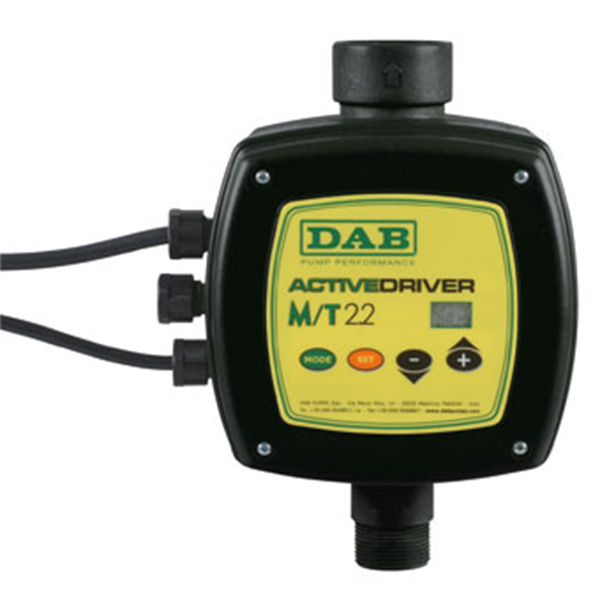
Pictured above: A Dab variable speed drive available from our online store.
What is a Variable Speed Drive (VSD) Pump?
A Variable Speed Drive (VSD) isn’t a pump itself, but rather, it is an electronic controller attached to a pump’s motor.
It regulates the pump’s speed by adjusting the frequency and voltage of the power supply, allowing the pump to speed up or slow down based on real-time water demand instead of running at 100% all the time, saving you electricity and keeping your pipes in good condition by controlling the amount of water that flows through.
Common Uses of VSD Pumps
VSD pumps are often used for:
- Home Water Supply: Maintaining steady pressure in showers and irrigation, even when multiple taps are running at once.
- Solar-Powered Systems: Because of their “soft start,” they don’t cause abrupt power surges, making them ideal for off-grid or hybrid solar setups.
- Commercial Buildings, Estates or Flats: Efficiently handling fluctuating demand across large complexes.
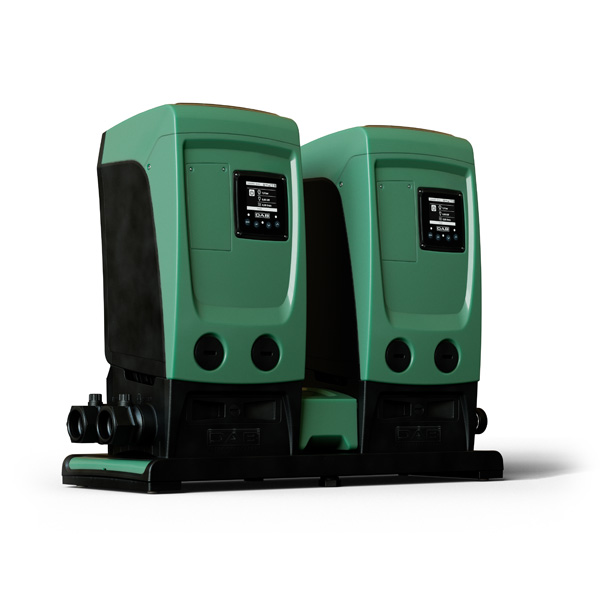
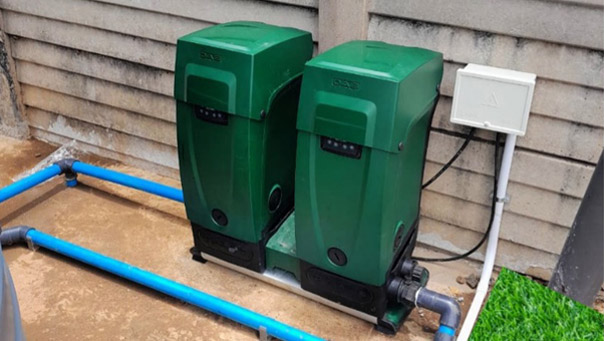
Example of a system that uses a VSD Pump in a DAB E.Sybox Mini Twin Kit
What is the difference between a VSD Pump and a VFD Pump?
This is the most common question that we get when it comes to VSDs, and it is a good question that will help you gain an understanding of where to use each one.
A VSD (Variable Speed Drive) is an umbrella term for any device that regulates a motor’s speed.
A VFD (Variable Frequency Drive) is a particular type of VSD that controls an AC motor’s speed by changing the electrical frequency and voltage as needed.
In modern AC pump systems, the terms are often used interchangeably.
Variable Frequency Drives (VFD)
- How it works: Changes the electrical frequency (Hz) supplied to the motor to adjust its RPM. It only works with AC motors.
- Best for: Applications where precise fluid pressure or system control is important. It dynamically speeds up or slows down to meet necessary demand, making it incredibly energy efficient.
- Advantage: Provides excellent soft-starting (which prevents water hammer in pipes) and steady pressure control, extending overall system life.
Variable Speed Drives (VSD)
- How it works: An umbrella term including VFDs, but also including older or different technologies. For example, a mechanical VSD may leave the motor running at full speed but use an eddy-current coupling or fluid coupling to reduce the pump’s shaft speed. It can apply to both AC and DC motors.
- Best for: Applications where adjusting the flow rate is the primary goal.
- Advantage: Usually, less expensive up-front than a standard VFD, especially in older or purely mechanical systems.
If you have any more questions, please reach out to us.
What Kind of Pumps Use a VSD Pump?
1. Booster Pumps
In residential complexes, commercial buildings, and municipal water supply, water demand fluctuates constantly.
-
- The pump detects a single tap opening and spins slowly to deliver just enough pressure. If a second or third tap opens, the VSD instantly speeds up the pump to maintain a constant, smooth water pressure throughout the system.
2. Borehole & Submersible Pumps
Borehole motors are highly susceptible to damage from constant “stop and start” cycles and power surges.
-
- VSDs provide a “soft start” feature for borehole pumps, gradually ramping the motor up to speed. This eliminates water hammer (shockwaves in the pipes) and reduces mechanical stress on the motor and impellers deep underground.
- It also allows the pump to match the yield of the borehole, preventing the pump from running dry if the water level drops.
3. Circulation & Air Conditioning Pumps
In air conditioning systems or large-scale hot water circulation, pumps move water through a network of pipes to manage temperature.
-
- As automated valves open and close across a building to regulate temperature, the system’s resistance changes. A VSD pump senses this change and slows down when fewer rooms require climate control, resulting in massive energy savings.
4. Irrigation and Agricultural Pumps
Farmers use VSDs on irrigation pumps to handle varying field sizes and different types of watering equipment (e.g., switching between centre pivots and drip irrigation).
-
- The VSD ensures that, whether you are watering a small patch or your entire farm, the nozzles receive the exact pressure required for an even spray, preventing over-pressurisation and burst pipes.
5. Industrial Process & Chemical Pumps
In manufacturing and chemical processing, liquids often need to be blended, transferred, or dosed at highly precise flow rates that vary with the product recipe.
- VSDs allow automated factory systems to tweak pump speeds on the fly to maintain exact flow control.
4 Benefits of a VSD Pump
- Energy efficiency: They consume +/- 80% less energy than traditional pumps because the motor runs at the required speed.
- Consistent pressure: A pressure transducer detects downstream pressure and adjusts the motor to maintain steady pressure.
- Built-In protections: Most VSDs have dry-run protection (it shuts off if the tank runs out of water) and leak detection built in.
- Longevity: Smooth starts and stops lessen the mechanical strain and wear on the pump’s internal components.
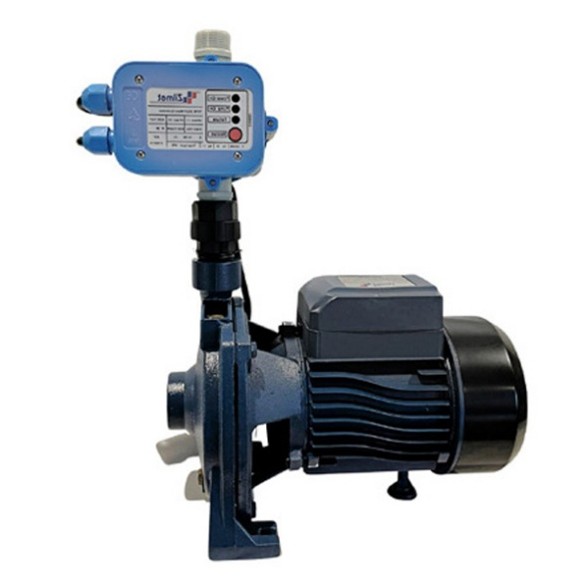
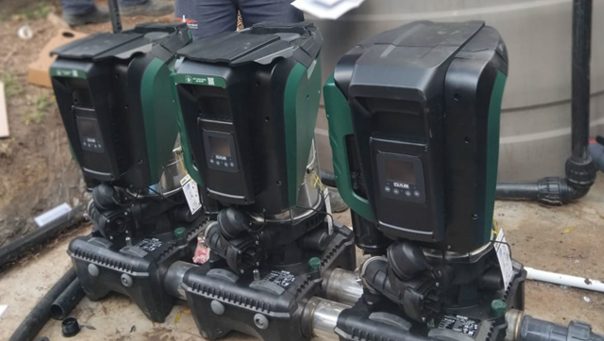
Example of a VSD Pump in a Zilmet ZIL 170-M+ZIL01 Controller 220V automatic booster pump
VSD Pump Sizing & Maintenance
Typical household sizes range between 1.0kW and 2.2kW, depending on flow rate requirements (e.g., the number of bathrooms and water needs).
To get the most out of your unit, ensure your suction pipes are adequately sealed, and check the pressure vessel’s air charge often.
Sizing Considerations
- System Head & Flow: Ensure your pump wet end is originally sized correctly for the Total Dynamic Head (TDH) and peak flow rate required. A VSD simply influences the pump curve, but it cannot make an undersized pump produce more pressure.
- Affinity Laws: Remember that with centrifugal pumps, power consumption drops with speed reductions. Operating a VSD pump can cause massive electricity savings, but make sure the VSD is programmed to avoid running the pump below its minimum safe continuous speed to prevent damage.
- Built-in Pump Protections: VSDs for water systems come with programmable systems for Dry Run Protection, Overload/Underload Protection, and Phase Loss.
Protecting Your VSD Pumps
One of the major benefits of a VSD on a pump is integrated system protection. Ensure you properly configure the drive’s guidelines for your specific setup.
Set up the drive for:
- Dry run protection: To stop the pump when the water source is depleted.
- Pressure transducer integration: Allows the pump to vary speed to maintain a constant line pressure despite constantly changing demand.
VSD Pump Prices
What is the average price range you can expect to pay for a VSD Pump?
The answer to this question depends on the pump’s usage and size. This part of the article will tell you the sizes available from AfriPumps, the price ranges and the best usage of those pumps.
1.0kW – R10,200 – R10,500
- Home Water Booster Pumps
- Small Borehole & Submersible Pumps (40 to 80 meters)
- Residential Irrigation Pumps
1.1kW – R10,500 – R10,800
- High-Demand Domestic & Light Commercial Booster Pumps
- Medium-Depth Borehole & Submersible Pumps (60 to 90 meters)
- Large Residential & Commercial Irrigation Pumps
- Swimming Pool & Eco-Filtration Pumps
1.5kW – R10,400 – R10,700
- Multi-Story & Multi-Dwelling Water Booster Systems
- Deep Borehole and High-Yield Submersible Pumps (80 to 130+ meters)
- Commercial Agricultural & Micro-Irrigation Pumps
- Large Commercial Pool & Water Fountain Circulation
1.8kW – R12,000 – R12,300
- High-Flow, High-Head Vertical Multistage Booster Pumps
- Deep Industrial & Agricultural Borehole Pumps (100 to 150+ meters)
- High-Volume Agricultural Irrigation Pumps
- Light Industrial Process & Wash-Down Systems
2.2kW – R10,800 – R11,000
- Large-Scale Commercial & Multi-Dwelling Booster Systems
- High-Head & High-Yield Submersible Borehole Pumps (120 to 180+ meters)
- Commercial Agricultural Irrigation Pumps
- Industrial Process, Filtration, & Wash-Down Systems
3.0kW – R15,300 – R15,600
- Commercial Multi-Pump Booster Sets (High-Rise & Estates)
- Deep, High-Yield Industrial & Agricultural Borehole Pumps (150 to 220+ meters)
- Large-Scale Agricultural Irrigation Pumps
- Industrial Fluid Transfer & Processing Pumps
5.5kW – R18,000 – R18,300
- High-Flow Vertical Multistage Pumps (Commercial & Municipal)
- Large-Scale Agricultural Irrigation & River Extraction Pumps
- Deep-Aquifer, High-Yield Submersible Borehole Pumps (180 to 280+ meters)
- Industrial Processing, End-Suction, & Chemical Pumps
* Prices are based on the average price range at the AfriPumps online shop in June 2026.
If you want to find out more information about the VSD pumps available in South Africa, go to our website.
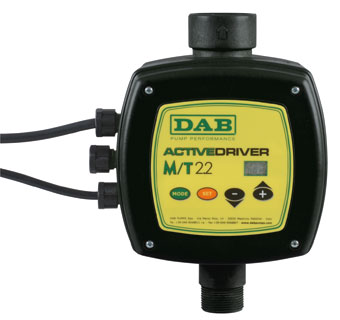
DAB Active Driver M/M 1.1kW
Essential Controls and Sensors of a VSD Pump
- Pressure Transducer / Transmitter: This continuously reads the water pressure in your system and reports the data back to the VSD. The VSD then speeds up or slows down the pump to keep the pressure perfectly constant, even if you open multiple taps at once.
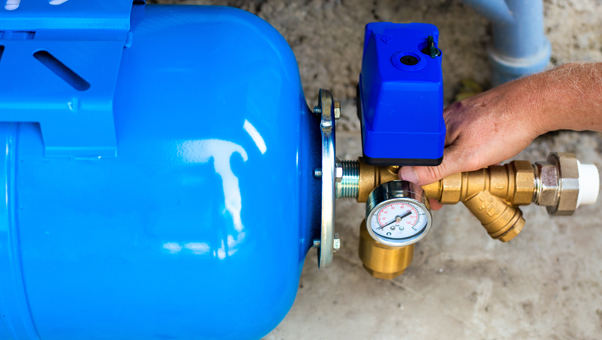
- Pressure Tank (Accumulator): A small bladder tank that stores a reserve of water. It prevents the pump from rapidly turning on and off (short cycling) every time a small amount of water (such as a single toilet flush) is used.
- Flow Switch: Some industrial or commercial setups use flow sensors to detect if the water is moving, prompting the VSD to start or stop the pump automatically as needed.

A DAB Esybox Diver multi-stage electronic pump comes with a variable speed drive
and is designed for use in wells or tanks.
Next Steps
To find out more about the water systems that you could use these pumps with, read this article about
Solar Pumps or Pressure Pumps. If you still want more information, you can reach out to us to answer any questions.
We also offer services, repairs and installations of water systems and pumps.