

If you’re thinking of buying a borehole, then you need to know about the most crucial component: the borehole motor. Often misunderstood, these powerful devices are the most important part of the borehole, and you need to understand as much as you can, and that’s where this guide will come in to answer as many of your questions as possible.
In this article, we’ll answer these often-asked questions about borehole motors:
- What’s the Difference Between a Borehole Motor and a Pump
- How Much is a Borehole Motor?
- Does a Borehole Motor Use a Lot of Electricity?
Borehole motor sizes: finding your perfect match
Most borehole pumps come with a motor. Some borehole pumps have an encapsulated motor, which makes it cheaper to replace only the motor as a replacement part.
If you’re interested in a new borehole pump, then please read our article about borehole pumps.
What's the difference between a borehole motor and a pump, and how do they interact?
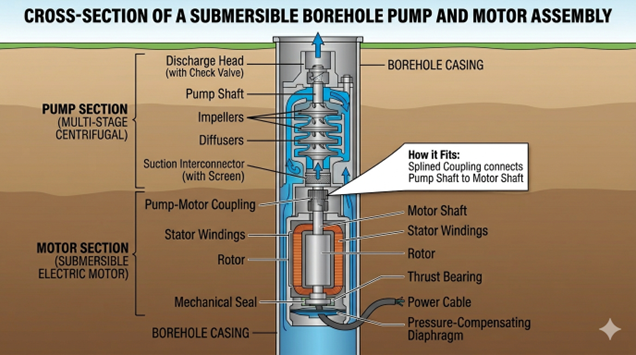
This is probably the most common question about boreholes.
Think of it like this:
- The borehole motor: This is the muscle, the engine. Its sole purpose is to convert electrical energy into rotational mechanical energy. It’s located at the bottom of your borehole, submerged in the water.
- The borehole pump: This is the heart, the actual water mover. It’s connected directly to the motor. As the motor spins, it drives the impellers within the pump, creating the pressure needed to push water up the pipe from deep underground to the surface.
They’re a lifelong team; the motor drives the pump, and the pump moves the water. You can’t have one without the other for a functional submersible borehole system.
How much is a borehole motor?
| Power Output (kW) | Voltage | Price (Approx. Incl. VAT) |
|---|---|---|
| 0.37 kW | 220V / 380V | R3,850 — R4,800 |
| 0.55 kW | 220V / 380V | R4,000 — R4,900 |
| 0.75 kW | 220V / 380V | R4,100 — R5000 |
| 1.1 kW | 220V / 380V | R4,500 — R5,200 |
| 1.5 kW | 220V / 380V | R5,250 — R7,800 |
| 2.2 kW | 220V / 380V | R6,500 — R9,600 |
| 3.0 kW | 380V | R11,400 |
| 4.0 kW | 380V | R15,800 |
Prices as of March 2026
Ask us questions here.
The price will depend on factors like:
- Horsepower (HP): Higher HP generally means more power and a higher price.
- Brand: Different manufacturers have different pricing structures.
- Material: Some motors are built with more robust materials for tougher conditions, impacting cost.
Single-phase vs. Three-phase: Three-phase motors for heavy-duty applications are often priced differently.
Does a borehole motor use a lot of electricity?
This is a very practical concern, especially with today’s electricity costs. The answer, like with many things, is that it depends on several factors, such as:
- Size matters: A larger, more powerful motor (higher HP) will inherently use more electricity than a smaller one to do its job. It’s like comparing the fuel consumption of a small car to a large truck.
- Run time: How long your pump system operates each day directly impacts your electricity usage. If you’re only pumping for an hour a day, your consumption will be far less than if it’s running continuously for a farm irrigation system.
- System efficiency: A well-designed and properly installed system will be more energy-efficient. This includes having the right size motor and pump for your borehole’s depth and water yield, as well as maintaining the system to prevent blockages or inefficiencies.
- Variable speed drives (VSDs): For those looking to optimize electricity usage, especially with larger systems, a Variable Speed Drive can be a game-changer. These devices allow the motor to run at different speeds depending on demand, significantly reducing power consumption when full power isn’t needed.
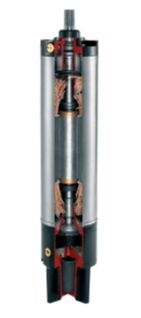
Pictured above: A cross-section of a Vansan submersible borehole motor.
In essence, while they do require electricity to operate, modern borehole motors are designed with efficiency in mind. Choosing the right size and considering options like VSDs can help manage your electricity consumption effectively.
If you have any questions, contact us.
Borehole motor sizes: finding your perfect match
Choosing the right motor isn’t just about price; it’s about matching the motor to your specific needs and borehole characteristics.
Here’s a general guide to some common sizes you might find, along with their typical uses and approximate water production capabilities.
Please remember, these are general estimations; actual performance depends on your specific borehole depth, water level, and the pump it’s paired with.
| Motor Size (HP) | Typical Use Case | Approximate Litres per Hour (L/H) - Varies Greatly |
|---|---|---|
| 0.5 HP - 0.75 HP | Small domestic supply, garden irrigation. | 1,000 - 2,500 L/H |
| 1.0 HP - 1.5 HP | Standard domestic supply, small farm, livestock. | 2,000 - 4,000 L/H |
| 2.0 HP - 3.0 HP | Larger domestic, small commercial, medium farm. | 3,500 - 6,000 L/H |
| 4.0 HP - 5.5 HP | Medium to large farm irrigation, light industrial. | 5,000 - 9,000 L/H |
| 7.5 HP - 10 HP+ | Heavy agricultural, industrial, multiple properties. | 8,000 L/H + (Can be much higher) |
Important note: The “Litres per Hour” is a very rough guide and is highly dependent on the pump selected and the total dynamic head (TDH) of your specific borehole (how deep the water needs to be lifted).
We recommend consulting our experts or referring to specific pump curve data for accurate flow rates.
Next Steps
After reading this article, you should have all your questions answered, and all your worries about
choosing the right borehole motor should be long gone.
Please read this article for more information on pressure pumps, which are
essential for bringing water from a borehole.


