
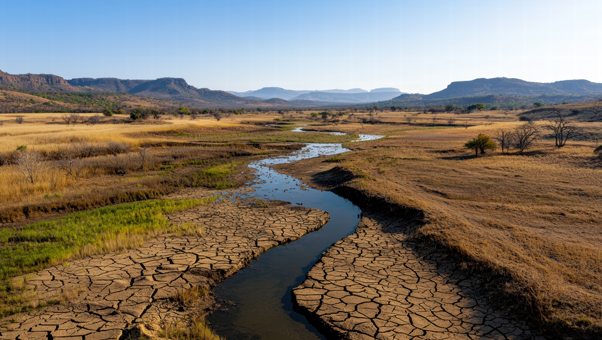
With summer approaching, South Africans are being urged to prepare for what lies ahead.
The South African Weather Service (SAWS) predicts less rainfall than usual and higher temperatures for most of the country from October 2026 into early 2027. They also mention that this El Niño might be the strongest we have experienced.
Leading to hotter days, drier gardens, and a risk of prolonged water outages.
This guide discusses:
- What El Niño is and its effects
- Practical drought prevention and preparation strategies
- Water storage solutions
- How to build drought resistant gardens
What is El Niño?
El Niño is a natural climate pattern that results in unusually warm sea surface temperatures in the central and eastern tropical Pacific Ocean.
This changes the planet’s climate circulation systems, leading to flooding in some areas and extreme heat and drought in others.
How El Niño elevated temperatures in Europe’s summer
Europe recently experienced a summer that shows El Niño’s impact on water, agriculture, and health.
Europe experienced its third-hottest summer and the lowest river flows on record. At some point, 52% of the continent faced “very strong” heat stress during the season.
According to the EU’s Copernicus, the “very strong” category begins at a feels-like temperature of 38°C.
The impact extended beyond temperature records, affecting:
- Water availability, energy systems, transport, ecosystems and human health.
Further down, we will discuss how El Niño is predicted to impact South Africa. Let’s discuss how you can prepare for the anticipated hot, dry conditions.
Drought prevention and preparation strategies in South Africa
No household can stop a drought, but every household can stop it from becoming a crisis at home.
Think of it in two parts:
- Prevention (using less so supply lasts)
- Preparation (having a plan and a buffer for when it does not).
Drought prevention strategies
1. Know your numbers
South Africa’s average use was about 217 litres per person per day in 2021, and Gauteng has been measured at around 305 litres.
To know how much you use, read your meter, divide by the people in your home, and set a target.
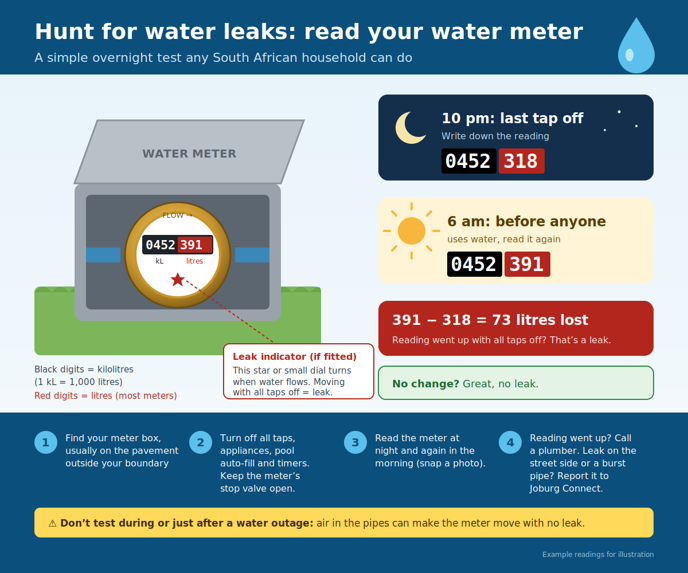
2. Hunt for leaks
Read the meter last thing at night and first thing in the morning with nothing running. If the numbers changed, you have a leak. A running toilet can waste thousands of litres a month.
3. Fit water-saving devices
Low-flow shower heads, tap aerators and a cistern displacement bottle or dual-flush kit cut use without changing habits.
4. Change a few habits
Take shorter showers, only do full loads of laundry, use a basin instead of running water for washing dishes and veggies, and avoid using a hose for cleaning pavements or cars.
What to do
- Store water before you need it.
- Use the water hierarchy during outages: drinking first, then cooking, personal hygiene, flushing, cleaning, and the garden last.
- Follow official alerts. Sign up for your municipality’s outage notices and check the SAWS forecasts, so restrictions and heatwaves are not a surprise.
How much water does a person need per day?
To survive, a person needs about 2.5–3 litres a day to drink, and more in a heatwave or when active.
The Sphere standards set 15 litres per person a day as a basic minimum for drinking, cooking and basic hygiene.
Cape Town’s 2018 drought shows what is realistic at home: residents were asked to live on 50 litres per person a day, and the city planned to hand out 25 litres per person a day from collection points if taps ran dry.
How much water should I store for an outage?
Store in two layers:
- Drinking and cooking water: at least 5 litres per person per day, for at least three days. A family of four needs about 60 litres in sealed containers.
- Household water for flushing and washing: use the 50-litre target.
Add a margin for heatwaves and longer outages: a 1,000–2,500 litre water tank comfortably covers most households for several days. If outages in your area regularly last longer, size up.
Water storage solutions
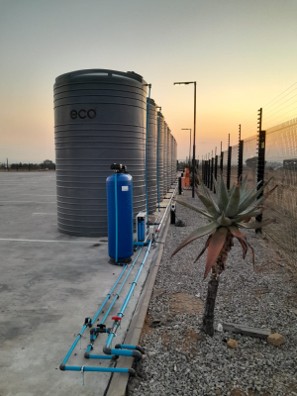
Storing water turns a drought or an outage from an emergency into an inconvenience. Here are the three main options, from simplest to most involved.
1. Water tanks
A water tank is the first line of defence for most homes and businesses.
Tanks range from about 260 litres for a small slimline unit to 20,000 litres or more, and come in vertical, slimline and underground designs.
Tips for choosing one:
- Size it to your outage risk: daily household use × the longest outage you expect, plus a margin.
- Add a pump and filter so stored water reaches your taps, toilets and geyser, not just a garden hose.
- Fit a float valve so the tank refills from the mains when supply returns and turn it over regularly so water stays fresh.
- Use a food-grade, UV-stabilised tank if the water may be used for drinking, and keep the lid sealed against mosquitoes.
2. Boreholes for water backup systems
A borehole draws groundwater from beneath your property and can supply a home through long outages.
Before drilling, keep in mind:
- Many municipalities require notification, signage or registration with the city, and most ban any connection between a borehole and municipal pipes.
- Test the water before drinking it; borehole water often needs filtering or treatment.
- Use a reputable driller and ask for a hydrogeological survey: there is no guarantee of water, and yields can fall in a drought.
- Treat it as a backup, not a licence to use more. Groundwater is shared and refills slowly, and experts warn against over-relying on boreholes during drought.
Explore our borehole pump guide that explains borehole pump types, sizes, and installation prices.
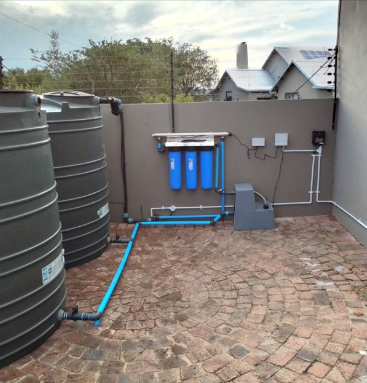
Discover how water backup systems work here.
3. Greywater diverters and treatment systems
Greywater is the lightly used water from showers, baths, basins and washing machines. It is roughly half of what many homes use indoors, and much of it can be used a second time.
Kitchen sink and dishwasher water (fats and food) and toilet water (blackwater) are not greywater and should not be reused at home.
Options range from a bucket to a plumbed system:
- Bucket method: keep a bucket in the shower to catch water while it warms up and as you wash, then use it to flush the toilet.
- Greywater diverter: a valve on the bath, shower or washing-machine outlet sends water to the garden through a pipe or drip line instead of the drain.
- Treatment system: filters and treats greywater so it can be stored briefly and used to flush toilets through the plumbing; best installed by an expert.
How to reuse greywater at home?
- Use it for flushing toilets and watering ornamental plants, lawns and trees.
- Pour or pipe it onto the soil at the base of plants, not over leaves.
- Rotate where you apply it so salts and soaps do not build up in one bed.
- Choose biodegradable, low-salt and low-phosphate soaps and detergents.
Is it safe to reuse shower or bath water?
Yes, for flushing and garden watering, if you follow some basic rules.
- Use it within 24 hours, because stored greywater quickly grows bacteria and starts to smell.
- Never drink it or use it for cooking, washing dishes or bathing. Keep it off fruit and vegetables you eat raw.
- Skip water that has been used to wash nappies or by someone who is ill and keep children and pets from playing in it.
- Do not spray it through sprinklers, which creates a fine mist that can be breathed in.
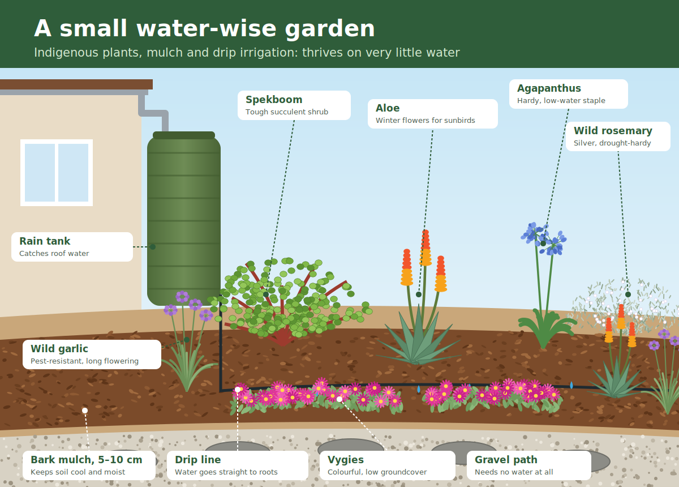
How to build drought resistant gardens
Healthy, covered soil holds water; bare soil loses it. These three steps make every drop of water that reaches your garden last longer.
Step 1: Cover your beds
Bare soil in summer sun can lose moisture within hours. A layer of mulch 5–10cm deep keeps soil cooler, slows evaporation and smothers thirsty weeds.
- Organic mulch: bark chips, wood chips, compost, straw, dry leaves or lawn clippings (dried first). These also feed the soil as they break down.
- Inorganic mulch: gravel or pebbles suit succulent and rock gardens.
- Living cover: low groundcovers shade the soil between bigger plants.
- Keep mulch a few centimetres away from plant stems to prevent rot, and water before you mulch so the moisture is locked in.
Step 2: Prevent soil erosion
Drought and erosion go together. Dry, bare soil blows away in wind, and when rain does come, it often falls as a hard storm that runs off instead of soaking in, washing topsoil with it.
- Keep soil covered with mulch or plants at all times.
- On slopes, use terraces, logs, rocks or plant rows across the slope to slow runoff.
- Dig compost into beds: soil rich in organic matter holds water like a sponge.
- Direct gutter downpipes into a tank or onto a planted area, never onto bare soil.
- Avoid digging or turning soil during the hottest, driest weeks.
Step 3: Plant water-resilient plants
Indigenous South African plants are adapted to heat and dry spells and, once established, survive on very little water. Good choices include:
- Spekboom (Portulacaria afra): a tough succulent shrub that thrives on neglect.
- Aloes: many species, with winter flowers that feed sunbirds.
- Wild garlic (Tulbaghia violacea): hardy, long-flowering and pest-resistant.
- Vygies (Lampranthus and relatives): colourful, low-growing groundcovers for sunny spots.
- Agapanthus, wild rosemary (Eriocephalus) and Cape plumbago: reliable, low-water garden staples.
Plant in autumn or after good rain where possible, so roots establish before the heat. Replacing part of a thirsty lawn with indigenous beds is one of the biggest long-term water savings a garden can make.
How El Niño impacts South Africa’s summer rainfall
In South Africa, most rainfall happens in the summer months, usually between October and March. During this time, El Niño often causes disruptions.
In an El Niño year, the systems that usually bring rain to the summer rainfall areas get diverted.
So, rain often arrives late, falls less often, and is followed by longer periods of dry weather. High temperatures dry out soil and dams faster.
Regional forecasters are certain that most of South Africa will get below-normal rain between November 2026 and February 2027.
Planning for a dry summer with chances of drought is the sensible bet.
In some regions, this scenario is made worse by ageing infrastructure and excessive losses due to leaks.
The link between El Niño, drought, and water outages
When El Niño causes low rainfall and high temperatures, river and dam levels decrease, leading to drought.
To prevent drought when dam levels fall below set thresholds, municipalities bring in restrictions.
During an El Niño summer, lower water supply, increased demand, and a delicate network can lead to longer, more frequent outages.
In cities, most summer outages are driven by heat rather than empty dams.
On hot days, everyone fills pools, waters gardens and showers more, and reservoirs and towers drain faster than pumps can refill them.
The Department of Water and Sanitation has warned that the Rand Water and uMngeni uThukela Water supply areas could face longer outages from October 2026 to March 2027 as heat drives up demand.
The effects of drought
Drought builds slowly and is easy to underestimate until the taps run dry. It affects:
- Water supply: dams and boreholes drop, and municipalities restrict use or cut supply to protect what is left.
- Food prices: smaller harvests push up the price of maize, vegetables and meat.
- Health: heatwaves raise the risk of heat stroke and dehydration, especially for older people, babies and outdoor workers, and poor water supply makes hygiene harder.
- Fire: dry veld and gardens burn more easily, and fires spread faster.
- Jobs and the economy: farms cut back on workers, and businesses that depend on water face higher costs and disruptions.
- Nature: rivers and wetlands shrink, and wildlife and livestock struggle for food and water.
Next Steps
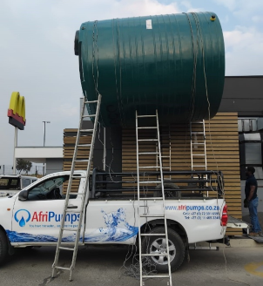
Get drought-ready with AfriPumps
AfriPumps supplies and installs the water backup and pumping systems this guide recommends:
- Water tanks and water backup systems for households. From slimline tanks for small properties to all-in-one tank-and-pump units so stored water reaches your taps, showers and toilets during an outage.
- Borehole pumps for homes. A wide range of submersible borehole pumps, sized to your borehole’s depth, yield and daily water needs.
- Solar pumps. For smallholdings and homes that need water independent of the grid and load-shedding, solar borehole pumps lift water from deep underground at a lower running cost.
- Irrigation water supply. Pumps for moving water from boreholes, dams and tanks to irrigation lines.
- Filtration. To make tank and borehole water cleaner and safer to use.
Drought equipment often faces issues due to incorrect pump sizing or faulty installation. This can lead to low pressure, pumps failing prematurely, or water not reaching the house.
Contact us for advice on a water backup system, borehole pump or solar solution before the summer heat peaks.


