
Have you ever been mid-shower when someone starts the washing machine, and suddenly your powerful stream of water turns into a sad little trickle? Or maybe you’ve noticed that the irrigation spray barely covers the row you’re targeting.
That frustration comes down to one thing: water pressure. When the “water muscles” aren’t strong enough to push liquid through the pipes, you need some help. That help is a booster pump.
In this article, we’ll answer the following questions about booster pumps:
- What is a booster pump?
- How a booster pump works
- What size should you choose?
- Prices of water booster pumps
- Three Pro tips
- About 0.75 kW booster pumps
- 1.1kW booster pumps
What is a Booster Pump?
At its simplest, a booster pump is a machine that increases the pressure and flow of water.
If you imagine your building’s plumbing as a series of highways, the water is the traffic. Sometimes, there aren’t enough “engines” to keep the traffic moving fast enough to reach the top floor or the far end of the building. The booster pump acts like a turbocharger for your pipes.
It doesn’t create water, it just takes the water that is already there and gives it a massive push.
Our technicians usually install these in homes where the municipal water pressure is too low, or in buildings that rely on large tanks to store rainwater or borehole water.
How a Booster Pump Works
To understand how a booster pump works, you have to think about Centrifugal Force.
Imagine holding a bucket of water and spinning your arm in a big circle really fast. If you spin fast enough, the water stays pressed against the bottom of the bucket.
A booster pump uses the same physics.
The Step-by-Step Process:
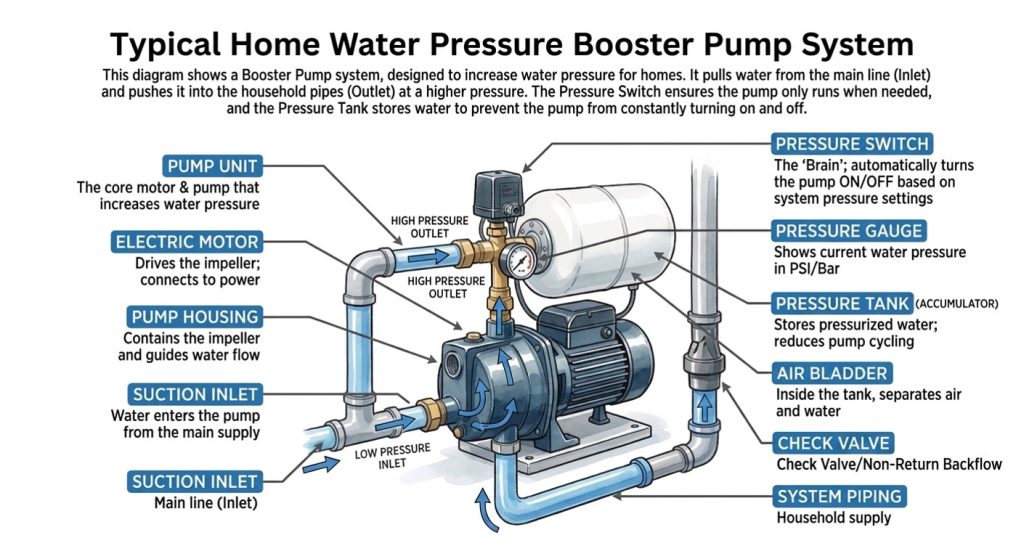
- The Intake: Water enters the pump through the inlet, from the main water supply, or from a water tank.
- The Impeller: Inside the pump is a spinning disk with curved blades called an impeller. This is powered by an electric motor.
- The Spin: As the impeller spins (usually at around 2,800 to 3,000 RPM!), it flings the water outwards to the edges of the pump casing using centrifugal force.
- Pressure Build-Up: Because the water is being thrown so hard against the walls of the casing, it gains energy. This energy turns into velocity (speed) and pressure.
- The Discharge: The pressurised water is then forced out through the outlet and into your home’s pipes.
Most modern booster pumps also have a Pressure Controller (that little plastic box on top). This is an important part of the pump. It senses when you open a tap and tells the motor to start spinning. When you close the tap, it senses the pressure build-up and shuts the motor off, so your pipes don’t burst.
Booster Pump Size: Getting it Right
In the world of pumps, “bigger” isn’t always “better.” If you get a pump that is too powerful, you might actually damage your plumbing.
When our technician talks about size, they aren’t just talking about how big the box is, they are looking at two main things:
- Flow Rate: How many litres of water can the pump move per minute?
- Head/Pressure: How high can the pump push the water vertically? (Think of this as the strength needed to climb a hill).
For a standard small house with one bathroom, a compact pump is fine.
For a large double-story house with three bathrooms and a massive irrigation system, you’ll need something with more muscle to ensure everyone can shower at the same time without the pressure dropping.
If you don’t get the right pump size, your pump could:
- Use too much power, resulting in a high electricity bill
- Create water pressure that is too low to do the work
- Wear out before it should
Our pump experts work with pumps all the time and know how to get the balance perfect.

Booster Pump Price: What are you paying for?
- The Motor Windings: High-quality pumps use copper wiring, which handles heat better and lasts longer. Cheaper ones might use aluminium.
- The Impeller Material: Cheap pumps often have impellers made of inferior materials, which can warp or crack if the pump runs dry.
Commercial pumps often use heavy-duty materials, depending on the usage, eg stainless steel in food-grade factories and cast iron for dirty water. - The Controller: A smart controller that protects the pump from “dry running” (running when there is no water) is more expensive, but saves you from buying a whole new pump later.
- The Noise Factor*: Many of the high-quality pumps are quieter to run, which is important in a home or work environment.
* Note: In our experience, this is a factor which many of our customers find to be very important, because noisy pumps can be distracting or keep people awake at night.
| Booster Pump Systems | Estimated Price Range | Best Use Case |
|---|---|---|
| 0.37KW | R1,700 – R8,500 | Small Residential Homes (1 Bathroom) |
| 0.75KW | R2,600 – R21,500 | Medium Residential Homes (2 Bathrooms) |
| 1.1KW | R3,700 – R35,500 | Large Residential Homes (3 Bathrooms) |
| 1.5KW (VSD) | R5,500 – R62,000 | Larger Residential Homes / Plots / Hotels or Offices |
| 2.2 KW | R42,500 – R63,500 | Commercial & Retail Spaces / Hotels and Casinos |
| 3 KW | R55,000 – R70,500 | Lodges, complexes, estates and commercial buildings |
| 4 KW | R64,000 – R74,500 | Large complexes, estates and commercial buildings |
* Prices as of April 2026
Check our other booster pumps here.
Or ask our advice on the quietest pumps for your application.
Water Booster Pump Pressure
Pressure is measured in Bar or PSI.
Most home appliances (like dishwashers and washing machines) like to work at around 2 to 3 Bar of pressure.
- If your pressure is below 1 Bar, your shower will feel like a leaky watering can.
- If your pressure is above 5 Bar, you risk blowing the seals in your taps or causing your geyser (water heater) to leak.
Our technician’s job is to “dial in” the pressure. We use the pressure controller to make sure the pump starts and stops at the perfect moment to keep your “water experience” consistent.
Booster Pump Pro Tips
In South Africa, many people use JoJo tanks or similar water storage tanks. Since these tanks usually sit on the ground, gravity isn’t strong enough to pull the water into your house with any real force.
When we install a pump for a water tank, we connect the pump directly to the bottom of the tank. This is called a Suction Line.
Pro Tip: Always make sure the tank is full.
If the pump tries to suck water and the tank is empty, it will suck air instead. This is called cavitation, and it sounds like the pump is chewing on gravel. It’s the fastest way to ruin a perfectly good machine.
To properly connect a Jojo Tank: Start by placing the tank on a flat, stable concrete base so it doesn’t tilt, then hook up a pipe from your roof gutters to the top of the tank. For more information on Jojo Tanks, read this article on Water Pumps for Jojo Tanks.
0.75 kW Booster Pump: The "All-Rounder."
The 0.75 kW (Kilowatt) pump is the most common pump you’ll see in suburban neighbourhoods.
- The Power: 0.75 kW is roughly equal to 1 Horsepower (HP).
- What it can do: It is perfect for a standard single-story home. It can easily run two showers at once and still have enough power to keep the toilet refilling quickly.
- Why people love it: It’s relatively quiet, doesn’t use a massive amount of electricity, and is very reliable for everyday use.
1.1 kW Booster Pump: The "Heavy Lifter."
When on a larger property with more power needs, we often recommend a 1.1 kW (Kilowatt) pump.
- The Power:1 kW is roughly equal to about 1.5 Horsepower
- What it can do: If you live in a double-story house, the pump has to fight gravity to get the water upstairs. That extra power is necessary to push the water up that vertical climb.
- Irrigation: If you have a large garden with 10+ sprinklers running at once, a 1.1 kW pump provides the high flow rate needed to make sure the last sprinkler in the line doesn’t just dribble.
- Multi-Family: If you have a main house and a garden flat (cottage) both using the same water source, the 1.1 kW ensures everyone stays happy.
- Why people love it: This pump is perfect for a larger house or a double-story house and is essential to make sure that the water pressure stays constant and consistent when needed.
Popular Booster Pumps in South Africa
We often recommend Dab Esybox booster pumps, as they have proven to be reliable in the 40+ years we’ve been servicing pumps in South Africa, as well as being relatively quiet.
Foras and Ebara pumps are also well known for their quality and reliability. Grundfos booster pump systems provide premium quality.
Zilmet booster pumps provide good value for money.

3 Golden Rules
If you’ve installed a pump, remember these three “Golden Rules”:
- Keep it Dry: Keep the motor dry. While the inside moves water, the electrical back-end hates rain. Always use a pump cover.
- Check the Filter: If you are pumping from a tank, leaves and sand can get in. A simple mesh filter on the intake saves the impeller from being sandblasted.
- Listen to the Sound: A healthy pump hums. A dying pump screams, grinds, or clicks. If it sounds weird, turn it off and call a pro!
Next Steps
If you need any help or have any questions, you can reach out to our knowledgeable technicians, or you can read our other article about a centrifugal water pump that will help expand your knowledge even more or read more about water storage tanks to find out which one suits your needs.