What is a Centrifugal Water Pump? (Including Different Types and Where to Use Them)
5 minutes of reading
We get asked many questions about Centrifugal Water Pumps by our customers, as they are widely used in South Africa.
When you need to move clean water, hot water, or light industrial liquids (without aggressive chemicals), these types of pumps are commonly used. For both domestic and industrial applications.
These are some of the questions people often ask us:
What is a centrifugal water pump and how does it work?
What is the difference between a centrifugal water pump and a “normal pump”?
What are the advantages and disadvantages?
Where are centrifugal water pumps used?
What types of centrifugal water pumps are there?
How long does a centrifugal water pump last?
Let’s dive right in and answer them.
What Is a Centrifugal Water Pump?
A centrifugal water pump uses a rotating impeller to move water through the pump and convert rotational energy into kinetic energy.
This design allows the pump to transfer large volumes of water efficiently.
How it works:
Water enters the pump through the suction inlet.
The impeller spins, creating centrifugal force.
The force pushes water out through the discharge outlet at high speed.
A durable cast-iron centrifugal pump – the single impeller Calpeda NM and NMD is used for water supply; or in heating, cooling and circulation plants.
What Is the Difference Between a Centrifugal Water Pump and a “Normal Pump”?
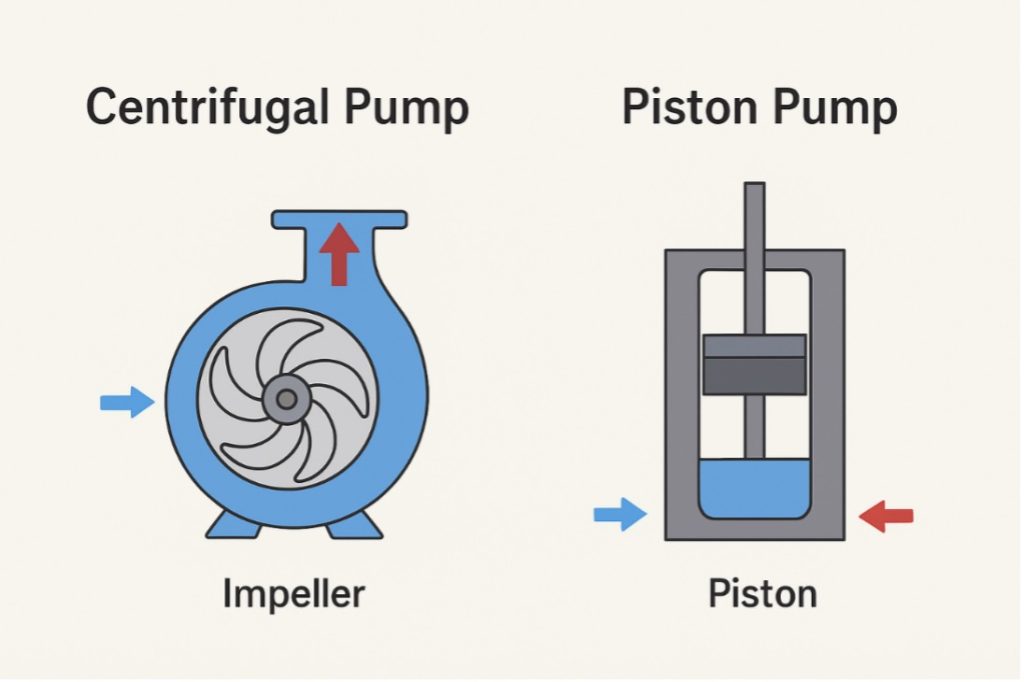
When people talk about a “normal pump” they’re usually thinking of a piston-type pump, which is known as a displacement pump. (Bearing in mind that there are also other pump types such as reciprocating, diaphragm, or peristaltic pumps.)
The main difference lies in the pumping mechanism:
Centrifugal pump – Uses a rotating impeller and is ideal for continuous, high-flow applications.
Positive displacement pump (piston type) – Moves a fixed amount of fluid with each stroke, suited to high-pressure, low-flow applications.
A Simple Diagram to illustrate the difference between a centrifugal pump and a displacement (piston type) pump
Advantages of a Centrifugal Water Pump
High flow capacity – Can move large volumes quickly.
Simple design – Easy to operate and maintain.
Versatility – Suitable for clean water, hot water, and certain chemicals.
Cost-effective – Affordable compared to many other pump types.
Disadvantages of a Centrifugal Water Pump
Not suitable for very viscous liquids.
Requires priming unless it’s a self-priming model.
Efficiency can drop if not operated near its design point.
What Are Centrifugal Water Pumps Used For?
Centrifugal pumps are used across industries and in homes because they move clean water efficiently.
Residential Uses: Domestic water supply and pressure boosting, irrigation, pool water circulation.
Commercial Uses: Water transfer in office buildings, hotels, and schools. Fire fighting pump applications.
Industrial Uses: Treating water systems, cooling towers and systems, boiler feeds, non-abrasive liquids.
Known for strength and durability, these pumps are suitable for heavy-duty applications and can handle slightly abrasive liquids.
A Dab Cast Iron Centrifugal pump
Centrifugal Pump for Hot Water
Designed with heat-resistant materials, these pumps can safely handle high-temperature fluids such as boiler feed water.
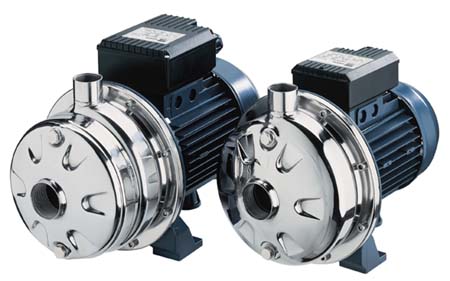
An Ebara Stainless Steel Centrifugal pump
Self-Priming Centrifugal Water Pump
Capable of removing air from the suction line, making them ideal where water supply may not be continuous.
A Calpeda Self-Priming Open Impeller Centrifugal pump - the pump re-primes itself even if partially filled with liquid and with completely empty suction pipe
Pedrollo Centrifugal Water Pumps
Pedrollo is one of the trusted brands we recommend with centrifugal pumps for domestic, agricultural, and industrial use.
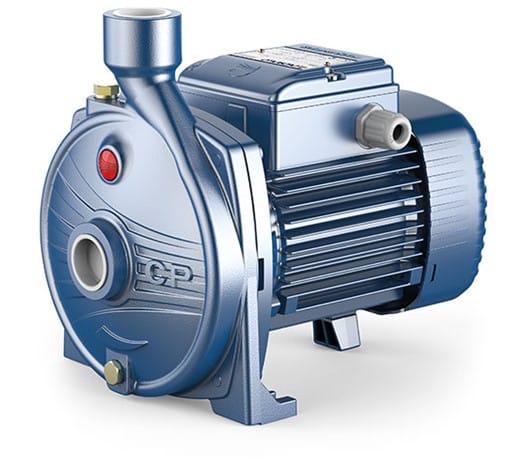
A Pedrollo cast iron centrifugal water pump - popular for clean water, for domestic and industrial drinking water applications. Complies with ISO 228/1.
If you need a cast iron centrifugal water pump, a Pedrollo centrifugal water pump, or a centrifugal pump for hot water, it’s important to match the pump specifications to your application.
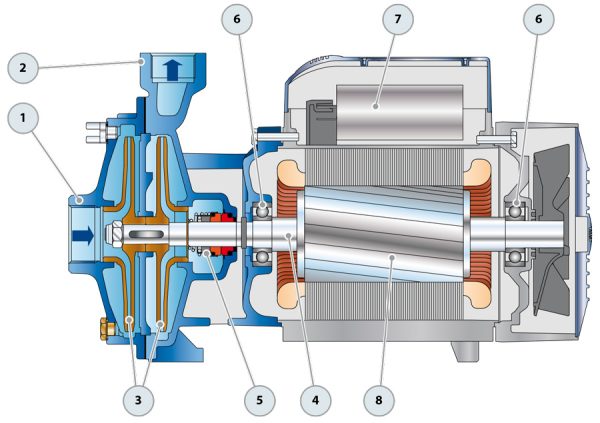
Pump body – Houses the pump components and directs water flow
Body back plate
Impellers – Rotating fins that impart velocity to water
Motor shaft – Connects the impeller to the motor
Mechanical seal – Prevent leakage
Bearings – Support the shaft and reduce friction
Capacitor – provides extra starting torque
Electric motor
* The above diagram shows an internal view of a Pedrollo centrifugal water pump’s parts
Spare Parts for centrifugal pumps
We keep stock of spare parts for most major brands of centrifugal pumps – including Dab, Ebara, Pentax, Pedrollo and Calpeda pumps. We also offer a repair service if need be.