

Choosing the right pump isn’t just about keeping the pool clean; it also has a major effect on your electricity costs.
A pump that’s too powerful will strain your filter and pipework, leading to costly repairs. It also won’t last as long as it should.
This guide will show you how to find a pump that is a good energy-efficient fit for your pool’s needs.
This article will answer the following questions:
- How to choose the right pool pump
- How to find your pool’s volume
- How to find your pool’s flow rate and what size pump you need.
- Pool pump prices
- How does a swimming pool pump work
- What type of pump does an above-ground swimming pool need?
- How the right swimming pool pump can save you money
The aim is to get clear water without an electricity bill that’s higher than it needs to be.
PS: Use our Handy Calculator to work out what size pump you need for your swimming pool in South Africa.
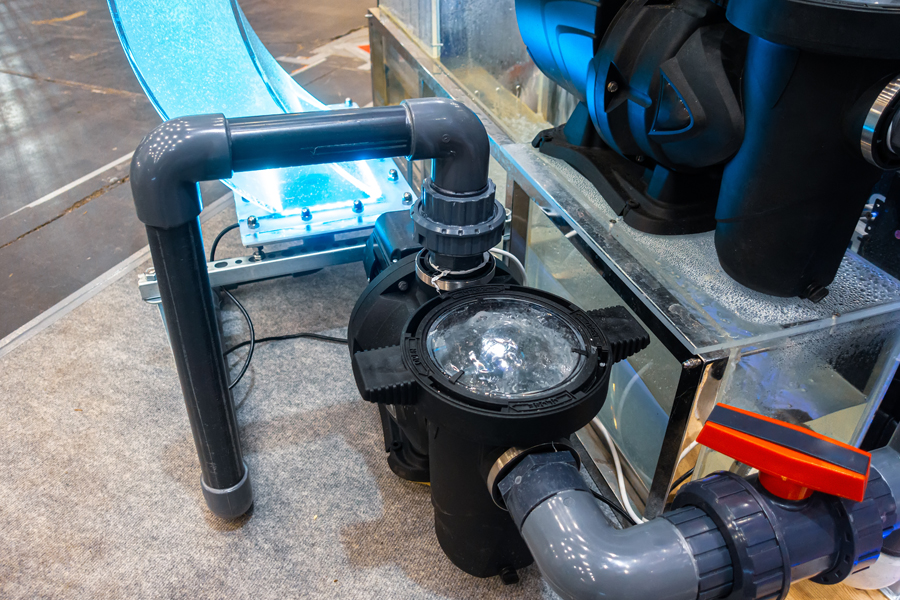
What size pump do I need for my pool?
Step 1: Find Your Pool's Volume (use the AfriPumps Calculator)
You need to know exactly how much water it has to clean. Your pool’s volume in litres is the foundation for everything else and getting it right is the most important step to ensure you are not under- or overworking your equipment.
Figuring out your pool’s volume is easier than it sounds:
- With a tape measure and a simple calculation, you can determine your pool volume in minutes.
- Just find the formula below that matches your pool’s shape.
AfriPumps Calculator for Swimming Pool Volume
| Shape | Formula (Dimensions in Meters) | Multiplier | Result |
|---|---|---|---|
| Rectangular | L x W x Avg Depth | x1000 | Total Liters |
| Round | 3.14 x R2x Avg Depth | x1000 | Total Liters |
| Oval | L x W x Avg Depth | x800 | Total Liters |
Step 2: What's Your Pool's "Magic Number"? Finding Your Target Flow Rate and knowing what size pump you need for your pool
What is the pool pump’s goal?
With your pool’s volume, the goal is to filter all that water within a reasonable timeframe.
The industry standard for this process, called the turnover rate, in South Africa, a standard turnover rate is 8 hours.
This rule of thumb ensures every drop of water gets cleaned at least once during the pump’s daily run cycle. This is the key to understanding your pool pump turnover rate.
Once you have your total Liters, you need to calculate the Flow Rate required to “turn over” the water.
Why is the Flow Rate (LPM) more important than the Kilowatts (kW) rating?
This LPM target matters far more than the kilowatt (kW) rating when comparing pumps.
In South Africa, you will notice that different models display their performance on a pool pump flow rate chart, which details their Liters Per Minute (LPM) output relative to “head pressure” (resistance).
Step 2.1: Calculate Liters Per Hour (LPH)
Divide the total volume by your target turnover time (8 hours).
Pool Volume (L)/8 Hours= LPH
Step 2.2: Calculate Liters Per Minute (LPM)
Since pump flow charts in South Africa use minutes, divide your LPH by 60.
LPH/60 minutes= LPM
AfriPumps Calculator for Swimming Pool Pump Sizes
| Pool Volume (Litres) | 8-Hour Turnover (LPH) (Litres Per Hour) | The "Magic Number" (LPM) (Litres Per Meter) | Recommended Pump Size |
|---|---|---|---|
| 20,000 L | 2,500 LPH | 42 LPM | Small swimming pool pump (0.45 kW) |
| 45,000 L | 5,625 LPH | 94 LPM | 0.75 kW swimming pool pump |
| 60,000 L | 7,500 LPH | 125 LPM | 0.75 kW swimming pool pump |
| 63,878 L | 7,985 LPH | 133 LPM | 0.75 kW or 1.1 kW pump |
| 80,000 L | 10,000 LPH | 167 LPM | 1.1 kW swimming pool pump |
| 100,000 L+ | 12,500+ LPH | 208+ LPM | 3 phase / Commercial pumps |
Which swimming pool pump works best for different Pool Pump Sizes, and what are the prices of those pumps?
Depending on the swimming pool pump brand you select, here is the average price range of what you can expect to budget.
| Size | Best Use | Price |
|---|---|---|
| 0.45kW | Splash Pool/Small Plunge Pool. (20 000L) | R4900 - R5200 * |
| 0.75 kW | Standard Pool (50 000L) | R5300 - R6000 * |
| 1.1 kW | Larger Residential Pool (80 000L) | R7500 - R13500 * |
| 3-phase | Commercial Pool (100 000L) | R45000 - R100000 * |
* Price range estimate as at January 2026.
For the current prices of pool pumps in South Africa, see our online shop here:
https://www.afripumps.co.za/product-category/swimming-pool-pumps/
Have more questions? Contact our experts today
Questions people ask about swimming pool pumps
Q: What type of pump does an above-ground swimming pool need?
Whether the pool is in-ground or above ground will impact on the type of pump needed.
We’ll try and explain why here:
1. Flooded Suction vs. Self-Priming Pumps
In South Africa, most in-ground swimming pool pumps are “self-priming.” This means they are engineered to pull water “up” from a weir that is lower than the pump itself.
Above-ground swimming pool pumps usually operate on Flooded Suction. Because the pump is positioned at the base of the pool (below the water level), gravity does the work for you.
- Engineering Impact: Since the pump doesn’t have to work hard to “lift” the water, it can actually be smaller and more energy-efficient (often 0.45 kW or smaller).
2. Resistance (Head Pressure) required
Above-ground pools usually have shorter pipe runs and smaller filters.
- In-ground pools: Have long underground pipes that create friction. This requires a 0.75 kW or 1.1 kW swimming pool pump to overcome that resistance.
- Above-ground pools: With pipes usually only 1–2 meters long, there is very little resistance. Putting a 1.1 kW pump on a small above-ground pool can actually create too much pressure, potentially bursting the flexible hoses or damaging the filter.
Here’s a link to one of our suggested above-ground pool pumps:
https://www.afripumps.co.za/product/speck-porpoise-22/
Q: How can the right swimming pool pump save you money?
1. Matching kW to Pool Volume (The “Goldilocks” Principle)
Do you remember the story of “Goldilocks and the three bears? – Everything had to be just right, the porridge couldn’t be too hot or too cold, and the beds couldn’t be too hard or too soft.
Your pool pump is similar, and many South African homeowners mistakenly believe a “bigger” pump is better. However, as pump experts, we can tell you that an oversized pump is a primary cause of wasted money.
- The Cost of Oversizing: If you install a 1.1 kW swimming pool pump on a pool that only requires a 0.75 kW model, you are paying for roughly 45% more electricity every single hour the pump runs without any added benefit to water clarity.
- The Cost of Under-sizing: Conversely, if the pump is too small, it won’t circulate the water fast enough to distribute chemicals. This leads to algae blooms, forcing you to spend thousands of Rands on “Pool Shock” and clarifiers.
2. Efficiency and “Head Pressure.”
Money is saved when a pump operates at its Best Efficiency Point (BEP).
- Clean Filters = Lower Costs: A pump has to work harder (drawing more Amps) to push water through a dirty filter. By maintaining your system, the pump moves more Liters Per Minute (LPM) for the same electrical cost.
Where can I get a swimming pool pump cover?

An Eco swimming pool pump cover
A swimming pool pump cover protects your pump from the sun, hail and storm damage, so that it lasts longer.
They range in price from R650 – R1 250.
Shop online for a swimming pool pump cover here: https://www.afripumps.co.za/product-category/pump-covers/

Where can I find a DAB Swimming Pool Pump?
Premium brands like DAB are engineered with tighter tolerances in the impeller and volute, meaning they convert electrical energy into water movement more efficiently than “no-name” budget models.
Read more about our DAB Pumps here: AfriPumps – water and booster pump brands we recommend
For Dab swimming pool pump prices, see here: Swimming Pool Pumps
How does a Swimming Pool Pump work?
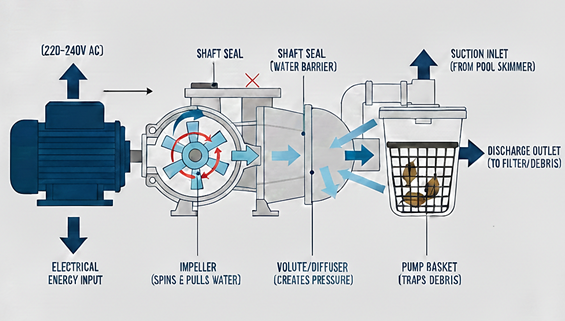
Pool Part and What it does:
- Suction Inlet: Where water enters from the pool weir/skimmer.
- Strainer Basket: Protects the internal components from debris.
- Impeller: The rotating part that creates centrifugal force.
- Volute/Diffuser: The housing that directs the water flow toward the filter.
- Shaft Seal: Prevents water from leaking into the electric motor.
- Motor: The power source that spins the impeller.
Next Steps
After reading this article, you should now understand how to choose a swimming pool pump.
You can walk past the energy-guzzling models with confidence, knowing you know how to find a smart pump for your pool.
Shop swimming pool pumps online:
https://www.afripumps.co.za/product-category/swimming-pool-pumps/
Have a question?
Contact us here to ask any questions: https://www.afripumps.co.za/contact-us/
